

 Billy Bagus
 Jan 06, 2026
Bali is often described as paradise, yet its true richness lies not only in scenery but in the rituals woven into everyday life. Long before a temple ceremony begins or incense fills the air, Balinese homes are already alive with preparation. Among the most essential and quietly beautiful traditions are mejejaitan and metanding, practices that transform simple natural materials into offerings of deep spiritual meaning. Read on to uncover why this delicate tradition remains one of Bali’s most enduring cultural expressions.

Among the most essential and quietly beautiful traditions are mejejaitan and metanding, practices that transform simple natural materials into offerings of deep spiritual meaning.
Ritual as Daily Practice
In Balinese Hindu life, tradition does not stand apart from daily routine. Cultural expressions such as dance, irrigation systems like subak, and ritual arts emerge naturally from everyday responsibilities. Offerings are made not only during festivals, but daily, often in the morning or afternoon, as a gesture of gratitude and balance between humans, nature, and the divine.
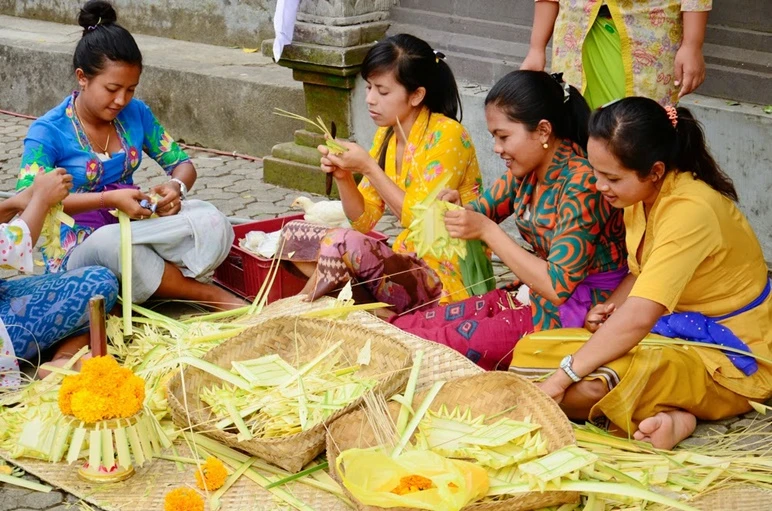
The preparation of these offerings is known as metanding, the process of arranging various elements into a unified offering called banten. Within this process lies mejejaitan, the intricate work of shaping and sewing young coconut leaves, or busung, into functional and symbolic forms. Together, these practices sustain the rhythm of Balinese spiritual life.
Coconut Leaves as Craft and Structure
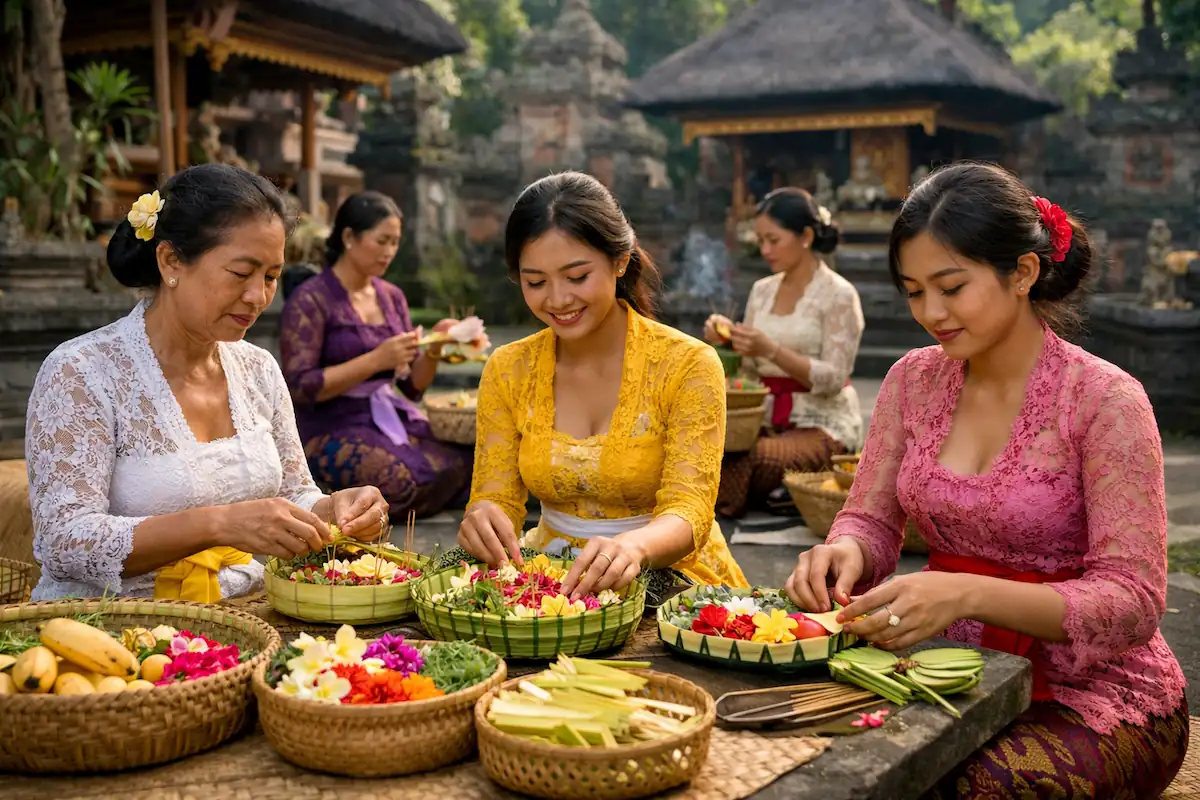
Mejejaitan involves cutting coconut leaves according to precise sizes and shapes, then sewing them using semat, small bamboo sticks that function as hooks or fasteners. What appears simple at first glance is in fact highly exacting work. Curves, squares, and layered forms are created with careful accuracy, forming small-scale structures that hold flowers and other offering components. Metanding usually takes place on tables or tikeh mats, sometimes in a bale, a special pavilion dedicated to preparation. These spaces function as communal workshops where knowledge, stories, and skills are shared alongside the work itself.
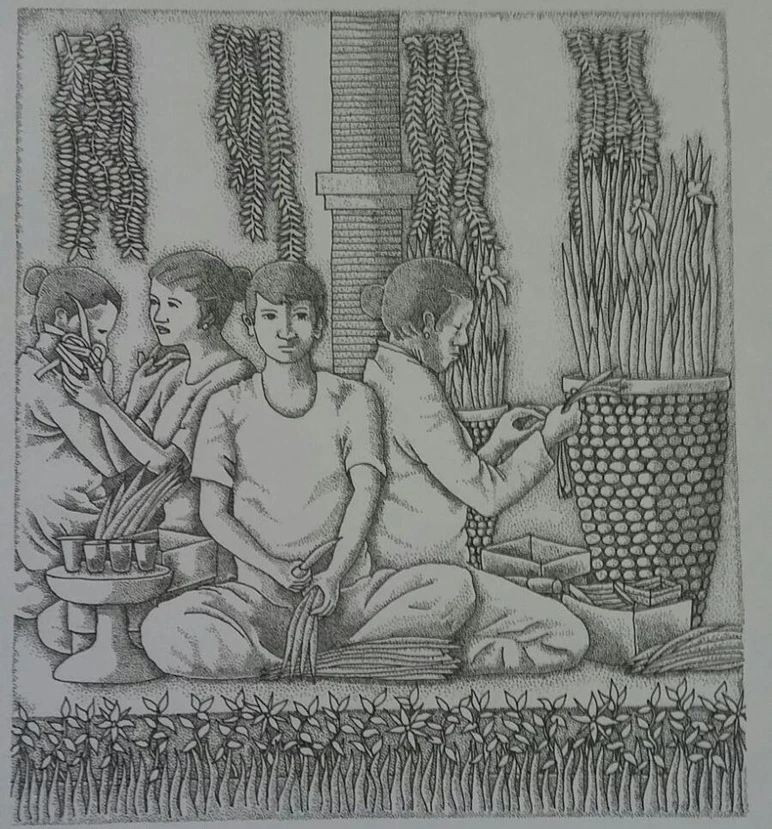
Through this process, Balinese people introduce concepts of shape, dimension, and balance in a tactile way. The coconut leaf becomes both material and structure, serving as a buffer and foundation for the offering. Each family or village may add customary elements according to local ordinances, giving subtle variation while preserving shared meaning.
Women at the Center of Spiritual Continuity
For Balinese women, mejejaitan and metanding are not occasional activities. They are central to daily life. From a young age, women learn by watching mothers, grandmothers, and neighbors, absorbing knowledge through repetition rather than formal instruction. Making offerings becomes a lifelong practice, blending devotion, discipline, and creativity.
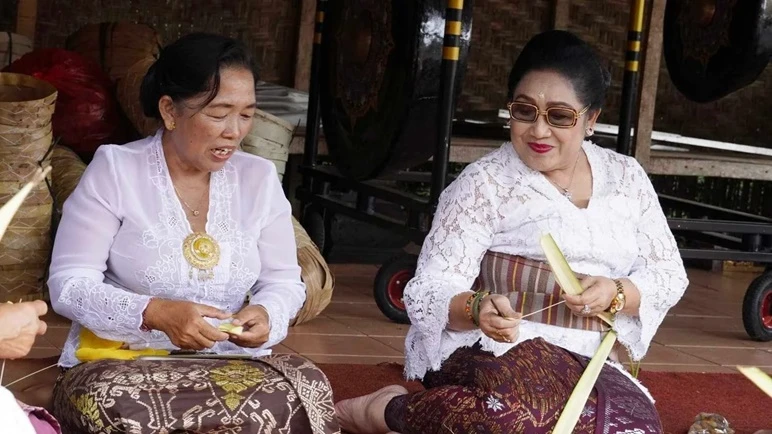
While men assist by gathering materials, climbing coconut trees, or preparing equipment, the act of assembling and sewing offerings is largely carried out by women. This places them at the heart of spiritual continuity. Every canang placed at a shrine or doorway carries the quiet labor of women whose hands sustain the island’s ritual life day after day.
Expression of Beauty and Faith
The most familiar offering in Bali is the canang or tangkih. Small yet visually rich, it combines flowers of different colors, leaves, incense, and woven coconut leaf bases. Each element contributes to a harmonious whole. Beauty is not decoration alone, but an offering in itself. The word canang signifies an offering to the gods. Created daily, it reflects mindfulness and balance, turning routine action into sacred expression. Beyond canang, Balinese women also prepare other offerings used for larger religious ceremonies, expanding the same principles to more complex forms.

For visitors, witnessing mejejaitan and metanding offers insight into Bali beyond spectacle. It is a living tradition, practiced quietly yet persistently, revealing how devotion, artistry, and women’s roles remain inseparable from daily life on the island.