

 Billy Bagus
 Jan 19, 2026
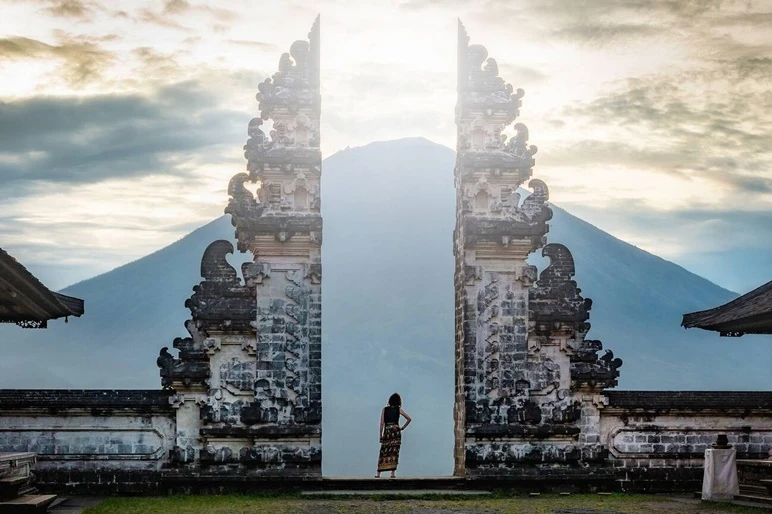
On Bali’s eastern edge, where the island grows quieter and the land begins to tilt toward the sky, Pura Lempuyang Luhur rises through mist and forest like a memory older than the island itself. Known globally as the Gate of Heaven, this sacred complex is often reduced to a single photograph, yet, beyond the iconic frame lies one of Bali’s most profound spiritual landscapes. Follow the path upward and discover why Pura Lempuyang Luhur remains one of the island’s most meaningful journeys.
This sacred complex is often reduced to a single photograph, yet, beyond the iconic frame lies one of Bali’s most profound spiritual landscapes.
The Island's Spiritual Axis
Pura Lempuyang Luhur is regarded as one of the oldest and holiest Hindu sites on the island, believed to predate most temples in Bali. Established around the eleventh century, the complex is part of Sad Kahyangan Jagad, the six principal sanctuaries that form Bali’s spiritual axis and safeguard the balance of the island.
Ancient Balinese manuscripts describe Mount Lempuyang as a fragment of Mount Mahameru, the cosmic mountain of Hindu cosmology. In these texts, divine forces transported pieces of Mahameru to Bali, forming its most sacred peaks. Mount Lempuyang is among them, making this site not only historically significant but cosmologically central to Balinese belief.
Seven Temples, One Ascent Toward Stillness
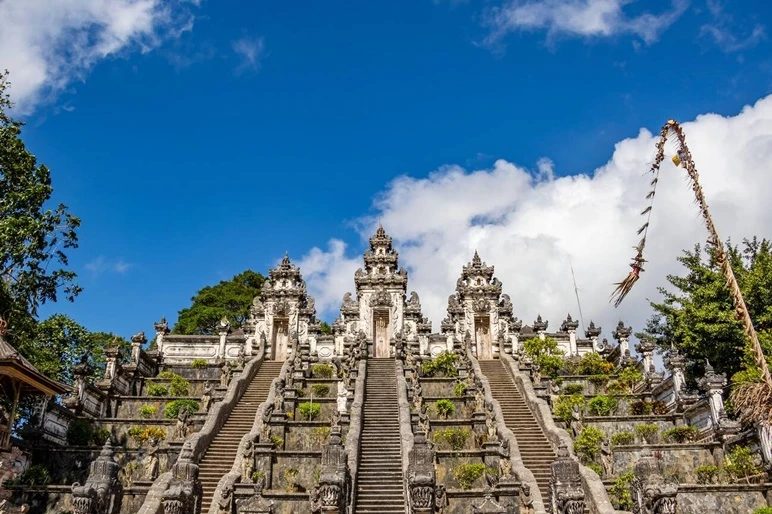
Unlike most temple sites, Pura Lempuyang Luhur is not a single destination but a progression. The complex consists of seven temples aligned along the slopes of Mount Lempuyang, each representing a stage in a spiritual ascent. The journey begins at Pura Penataran Agung Lempuyang and culminates at Pura Lempuyang Luhur, perched near the summit of the mountain.
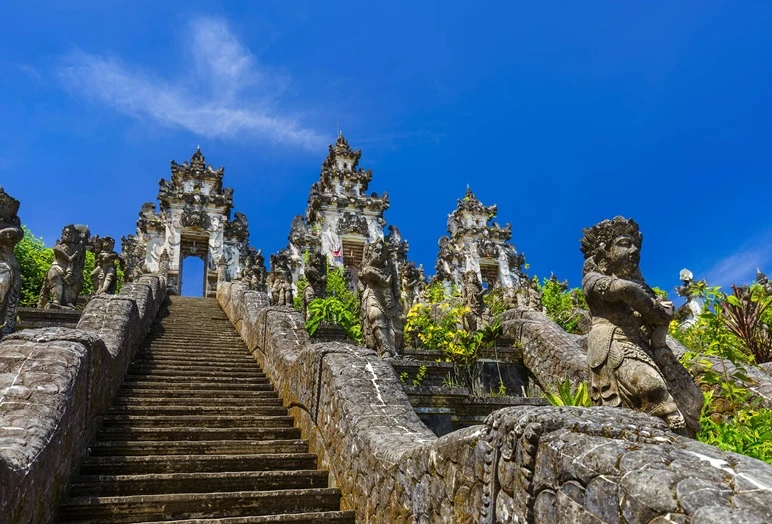
The path between them is steep and deliberate. More than 1,700 stone steps wind through dense tropical forest, passing shrines, moss-covered walls, and quiet clearings scented with incense. Locals believe the climb mirrors an inner journey. Complaints are discouraged, not as folklore, but as a reminder that spiritual progress requires patience and humility.
A Perfect Symmetry
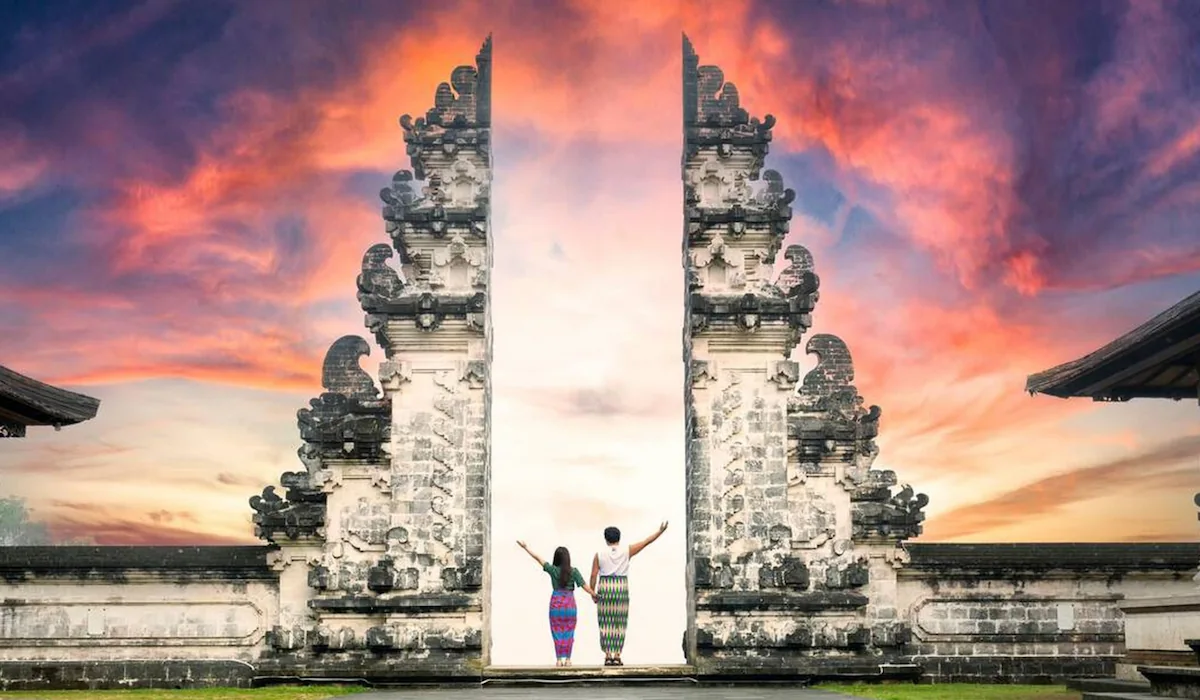
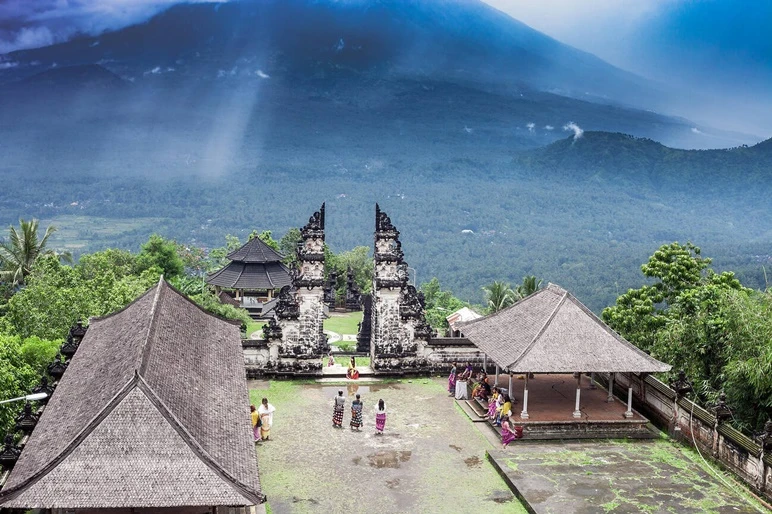
The world knows Pura Lempuyang for its gate, a towering candi bentar split gateway that frames Mount Agung in near-perfect symmetry. On clear mornings, the volcano appears suspended between the stone halves, creating a vision that feels carefully composed by nature itself.
This architectural form is not decorative. The split gate symbolizes balance, the meeting of earthly and divine realms. The famed reflective photographs taken here rely on simple mirrors rather than water, but the illusion has never been the point. For worshippers, the gate marks a threshold, a reminder that beyond it lies sacred ground.
The Illusion That Traveled the World
The photograph that carried Pura Lempuyang Luhur onto the world stage is built on an illusion. The mirror-like reflection beneath the Gate of Heaven is not a pool of water, but a simple photographic technique using a handheld mirror placed below the camera lens. This subtle trick transforms the split gate and Mount Agung into a perfectly symmetrical image, one that feels almost celestial. Shared endlessly across social media, the image reshaped the temple’s identity for a global audience and turned a quiet sacred threshold into one of Bali’s most recognizable visual icons.
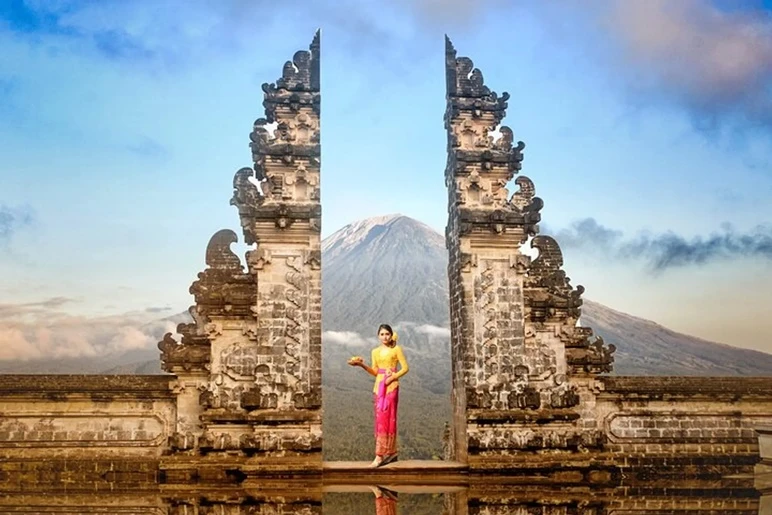
Yet the reflection itself is only a translation, not the source of the magic. Long before cameras arrived, the gate symbolized balance and transition in Balinese cosmology, marking the passage between the earthly and the divine. The illusion merely gives visual form to ideas already embedded in the architecture and landscape. For travelers who look beyond the frame, the true impact of Pura Lempuyang Luhur lies not in the photograph, but in the stillness beyond it, where mountain air, devotion, and time move at a different pace.
Lingers Beyond the Summit
Reaching the upper temple is not the end of the experience. The reward is not only the view, but the stillness that settles after the climb. Pura Lempuyang Luhur offers no spectacle beyond what nature and devotion already provide. Its power lies in restraint, endurance, and continuity.
In a landscape increasingly shaped by speed and surface impressions, Pura Lempuyang Luhur stands apart. It is a reminder that Bali’s deepest stories are found not on its beaches, but along quiet mountain paths where history, belief, and landscape converge. Those who take the time to ascend do not simply visit a temple. They participate in one of the island’s oldest conversations between earth and sky.