Indonesia Economic Outlook 2027 National Seminar
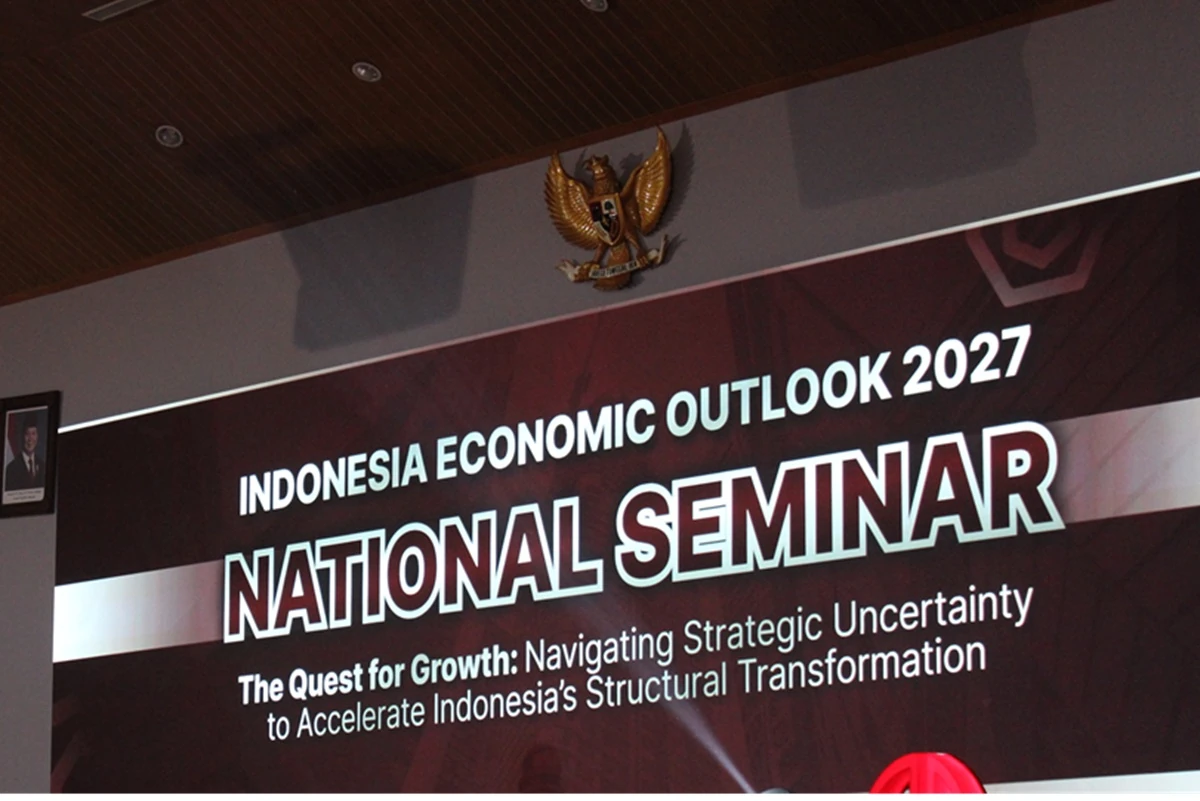
“The Quest for Growth: Navigating Strategic Uncertainty to Accelerate Indonesia’s Structural Transformation”
Indonesia Economic Outlook 2027 has successfully held its National Seminar under the theme “The Quest for Growth: Navigating Strategic Uncertainty to Accelerate Indonesia’s Structural Transformation” at the Purnomo Prawiro Multipurpose Hall, Faculty of Social and Political Sciences, Universitas Indonesia.
The event featured a line-up of speakers from leading institutions: Sandiaga Uno (Minister of Tourism and Creative Economy, 2020–2024), Intan Murnira Ramli (Senior Policy Fellow in the Policy Design Department at ERIA), Andrinof Achir Chaniago (Minister of National Development Planning of Indonesia, 2014–2015), Eddi Danusaputro (Chairman of Amvesindo), Hadi Setiawan (Mid-Level Policy Analyst, DJSEF), Dian Ayu Yustina (Head of Macroeconomic & Financial Market Research Department, Bank Mandiri), David E. Sumual (Chief Economist, PT Bank Central Asia (BCA) Tbk.), and Dr. Eugenia Mardanugraha, S.Si., M.E. (Commissioner of the Indonesian Competition Commission, KPPU). The session was moderated by Harry Baskoro (Senior Fellow at CIPS).
By highlighting the issue of strategic uncertainty in the global economy, the event aimed to serve as a forum for discussion for the public, especially students and economic observers, to understand the various challenges Indonesia faces in sustaining and accelerating national economic growth. Through macroeconomic and sectoral perspectives, the seminar explored the policy strategies needed to drive Indonesia’s structural transformation toward a more productive, inclusive, and globally competitive economy.
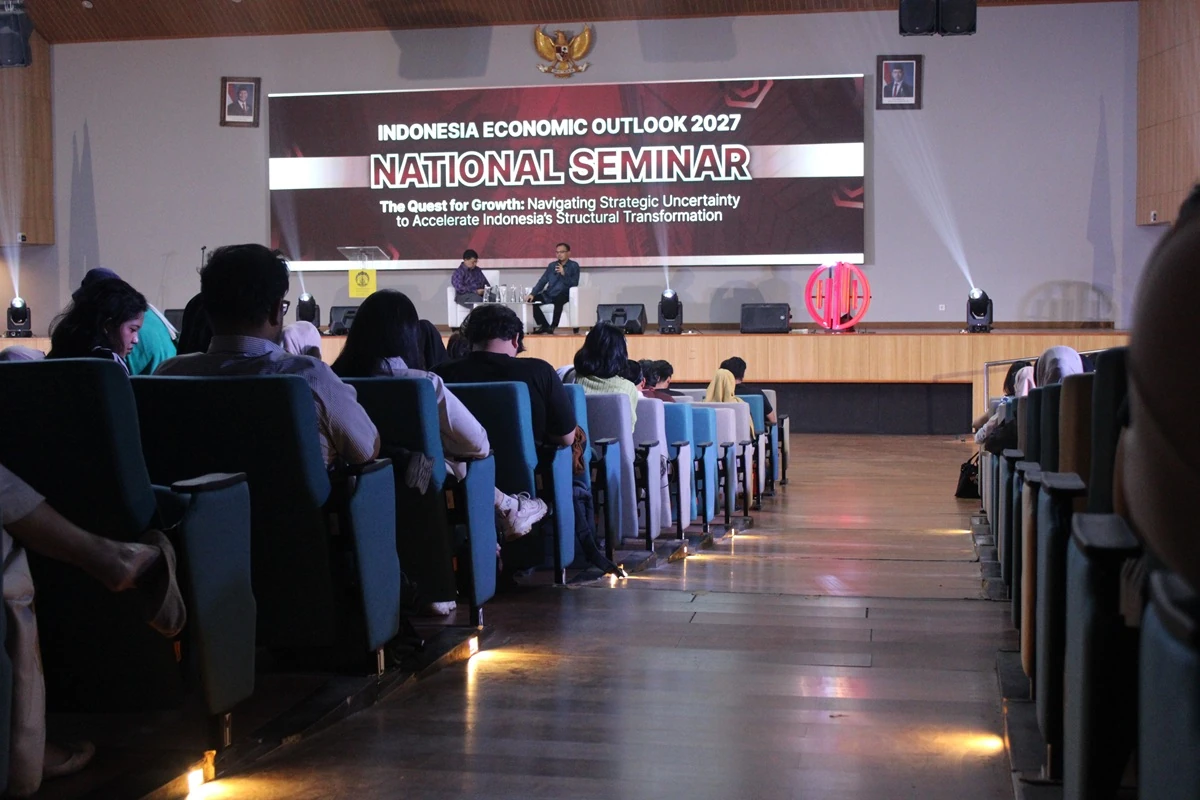
The IEO’27 National Seminar began with opening remarks by Sandiaga Uno, Minister of Tourism and Creative Economy (2020–2024), delivered virtually. In his speech, he emphasized that Indonesia is currently in a phase of strategic uncertainty. This condition was said to produce sporadic policies that increase the risk of miscalculation and strain domestic stability. He also praised the resilience of Indonesia’s economic growth, which has remained above 5% despite these pressures. However, he stressed the need for structural transformation so that Indonesia’s economic growth can exceed 5% and gradually move toward 6% to 8%. He also noted that all sectors, whether real, fiscal, or monetary, must work in synergy to strengthen Indonesia’s international standing and the competitiveness of the domestic economy.
The seminar continued with the national keynotes session, delivered by former Minister of National Development Planning Andrinof Achir Chaniago and Amvesindo Chairman Eddi Danusaputro. Andrinof Achir pointed to the need to develop a new economic theory to achieve consistent economic growth. He also stressed that a nation’s success requires leaders who collaborate with experts, rely on a scientific approach, and are open to hearing criticism and bad news. Eddi Danusaputro then highlighted that Indonesia’s digital ecosystem still lags behind other countries. In his view, improving the quality of human resources is essential to address this challenge. He also encouraged the younger generation to start building sustainable businesses in order to achieve financial stability and long-term investment.
Both national keynotes were followed by the international keynote, delivered by Intan Murnira Ramli. She discussed Indonesia’s economic growth target, from 5.47% to as high as 8% by 2029. This target demands a shift in development strategy, from the short term toward capital-intensive development. To realize this transition amid global and domestic challenges, collaborative, science-based leadership is needed, one capable of driving development in a focused and sustainable manner.
The seminar then moved on to the sectoral speakers sessions, starting with David E. Sumual on the real sector. He discussed the state of Indonesia’s manufacturing industry, whose contribution to GDP has declined from 22% in 2019 to 19% in 2026. Although foreign investment in nickel and bauxite downstreaming projects has boosted exports, the manufacturing sector still faces various challenges, from global geopolitical uncertainty and supply chain disruptions to rising energy prices that squeeze production costs and company profits. This has led many businesses to adopt a wait and see stance.
According to him, developing the manufacturing industry cannot rely solely on investment and infrastructure development; it must also focus on improving competitiveness and the quality of local human resources so that they can master technology and compete in global supply chains. In closing, moderator Harry Baskoro stressed that strengthening the manufacturing industry and human resource capacity are important steps for driving Indonesia’s future economic growth.
The sectoral speakers sessions continued with Hadi Setiawan’s presentation on the fiscal sector. He explained that the state budget (APBN) has performed fairly well. As of October 2026, central government spending had reached 74.4% of target, while Transfers to Regions (TKD) had reached 94% of the APBN ceiling. On the revenue side, tax revenue grew by 23.2% thanks to increased economic activity and optimized data integration through the Coretax system. In addition, excise revenue also showed positive growth.
The sectoral session on monetary and financial affairs was delivered by Dian Ayu Yustina. She discussed the challenges facing Indonesia’s economy due to global geopolitical tensions, particularly the conflict in the Strait of Hormuz, which has pushed up oil prices and disrupted energy supply chains. This has also increased inflationary pressure and affected people’s purchasing power. To maintain economic stability, Bank Indonesia continues to monitor movements in the rupiah exchange rate and inflation through monetary policy. She also highlighted the growing threat of cyberattacks that could disrupt the payment system, the banking sector, and national business activity.
In the final session, KPPU Commissioner Dr. Eugenia Mardanugraha offered reflections on the importance of building economic growth that is not only high, but also productive, competitive, inclusive, and sustainable. She stressed that amid global uncertainty, Indonesia needs to seize opportunities to strengthen domestic industry, attract investment, and improve competitiveness. She also expressed hope that the outcomes of the discussion would serve as input for formulating Indonesia’s future economic policy.
The IEO’27 National Seminar concluded with a Q&A session with participants. Questions focused on Indonesia’s fiscal readiness in managing public debt, the direction of monetary policy, and the resilience of the real sector in facing global uncertainty. From the discussion, the speakers agreed that efforts to accelerate economic growth must go hand in hand with prudence in managing uncertainty.
Amid global strategic uncertainty, policy quality, institutional credibility, and regulatory certainty are the keys to driving structural transformation toward a more productive, inclusive, and globally competitive economy. Through this seminar, IEO reaffirmed its commitment to providing analysis and a space for dialogue for the public, academics, and policymakers in formulating Indonesia’s development strategy amid increasingly complex global challenges.
Discover More




Related Articles

Trending Now